
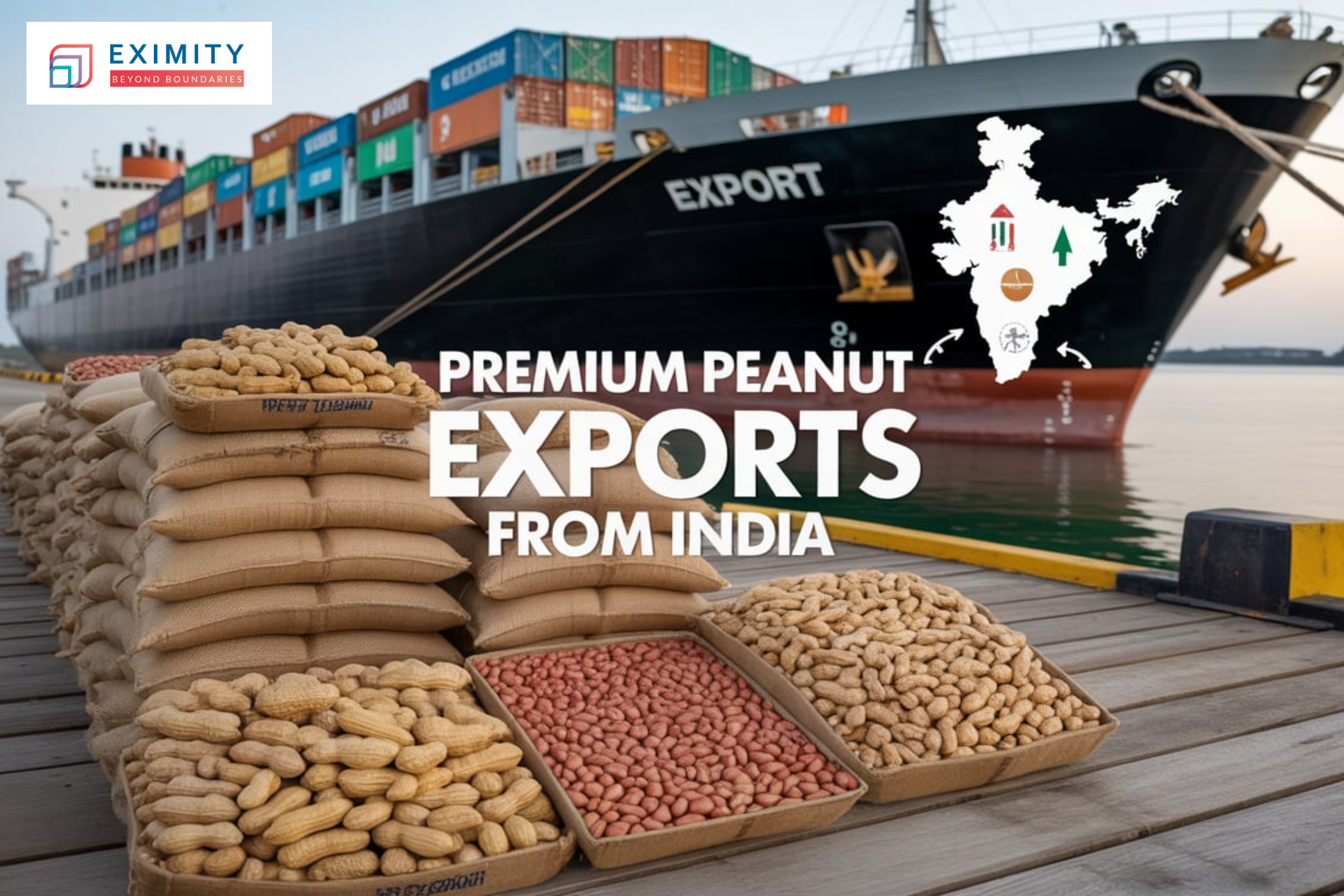
Introduction: The Growing Demand for Indian Peanuts
India’s position in the world of agriculture is well established as one of the top producers and exporters of groundnuts, as peanuts are called in India. The Indian peanuts are famous throughout the world for their oil-rich content, delicious taste, and other nutritional benefits. India’s groundnuts industry is especially important in the context of India’s export economy as it is an answer to the increasing global demand for plant-based proteins and healthy snacks.
Peanut Export from India: Current Status and Growth
The market for peanut export from India has shown impressive growth in the past decade.
The market for peanut exports from India has grown tremendously over the last decade. India sells raw, roasted, blanched, and in-shell peanuts to 90 plus countries. Major clients are Indonesia, Vietnam, Russia, and the UAE. The states of Gujarat, Rajasthan, and Andhra Pradesh lead the exports, with Gujarat supplying a considerable share of the country’s total tons traded.
Exporters must complete all paperwork aligned with international trade agreements. For newcomers in the industry, acquiring the necessary document for export is vital, such as permits or identifying licenses.
Export of peanut from India: What the Data Tells Us
The export of peanut from India shows strong yearly growth alongside considerable demand during off-harvest periods in other countries. According to trade data, India exported over 600,000 metric tons of groundnuts in the previous year. This number is predicted to grow exceedingly, specifically in the non-GMO and environmentally friendly agriculture sectors.
India’s stronghold in groundnut exports is further validated by its inclusion in the official “Top Products Exported from India” highlighting peanuts as a key player among major agri-commodities.
Peanuts Exporters in India: Who’s Leading the Industry?
There are a few large and small scale peanuts exporters in India. They usually possess integrated processing units which can clean, sort, grade, and vacuum pack peanuts to international standards.
Exporters are mainly concentrated in Gujarat and Maharashtra and have easy access to large-scale production and storage facilities as well as ports which makes international circulation seamless.
Groundnuts Exporters from India: Challenges and Compliance
For new and seasoned groundnuts exporters from India, the areas of primary focus remain aflatoxin limits, ever-changing phytosanitary standards, export traceability and monitoring system. Such exporters have to comply with specific restrictions issued by APEDA and other governing trade bodies.
Buyer requirements are important such as custom labeling, organic certification, and food safety audits
How to Export Peanuts from India: Step-by-Step Guide
Successful exports of groundnuts entail strategic foresight, adherence to the law, and well-structured supply chains. Here’s how to export peanuts from India
Complete Your Business Registration
Apply For IEC: Acquiring the Importer Exporter Code (IEC) with the DGFT is the first step that grants you a license to operate for peanuts export business.
Acquire Indian Peanuts of Export Quality
Engage With Trusted Suppliers: Secured contracts with farmers and traders from Gujarat and Rajasthan considered lead producers of Indian peanuts.
Choose The Correct Variant: Pick between Bold, Java, or Red Skin peanuts, guided by demand.
Carry Out Testing and Certification
Ensure Compliance For Aflatoxi:
Before exports, test aflatoxin levels and moisture content.
Issue Required Certifications
Depending on your buyers, obtain APEDA registration and other certifications like FSSAI or Organic.
Export Labeled Packs
Adheres To Global Packaging Standards
Packaging needs to include country of origin, net weight, grade, and expiry date.
Schedule Shipper And Cargo
Pick A Freight Forwarder
Partners dealing with agri-exports are preferable. Shipping through sea routes from Gujarat ports is most common and cheapest.
Managing Borders: Processes, Documentation, and Control
Draft Export-related Documents
The export documentation includes the invoice, packing list, bill of lading and certificate of export.
Clear Customs In India
Engage a CHA and achieve quicker clearance while ensuring correct embarkation export-supplying bill of declaration.
Starting a Peanut Export Business: Key Insights
For starting a peanut export business, understanding the international market’s demand, purchasing habits of the buyers, and the supply chain’s logistical sensibilities is essential. To manage risk, small test shipment exports to more responsive markets is advisable.
Without direct investment in internationally recognized certifications such as HACCP, FSSAI, and ISO, large global clients will remain unattainable. New exporters can also take advantage of government schemes and subsidies aimed at boosting exports, which help mitigate financial burdens.
Peanut Export Trends 2025: Future Outlook
With rising health concerns, consumers around the world are on the lookout for clean labels and protein–rich foods. This is evident as the peanut export trends 2025 show a sharp rise in the demand for organic and processed peanuts. There is an emerging demand for ready-to-eat peanut snacks, peanut butter, and protein bars in the European and American markets.
Additionally, adopters of sustainability practices have made Indian exporters to eco-friendly businesses more poised to satisfy shifting buyer needs as sustainability becomes a global concern.
Peanut Export Supply Chain: From Fields to Ports
A well-constructed peanut export supply chain starts at the level of the farm. The operations that harvest and post-harvest of peanuts involves grading, cleaning, quality control testing, shelling, and meticulous packaging into export ready forms. Quality is preserved through careful control of moisture and atmosphere during the preservation phase while in transit.
Logistics partners safeguard the timely transfer from the warehouse to the port. Exporting firms guarantee that every link in the chain is properly coordinated and all necessary materials readily available to guarantee smooth flow.
Peanut Quality Standards for Export: Meeting Global Expectations
Peanut quality standards for export stipulate certain limits for aflatoxin, pesticide residues, and microbiological compliance. Buyers require peanuts to be dimensionally, flavor-wise, and moisture-wise within set parameters, free of contamination, and without excessive occupancy submitted by competitors.
Exporters need to comply with bound regulations such as CODEX, EU food law, and the country’s laws of the recipient. Continuous testing done by outside independent evaluators, along with proofable reporting, helps minimize the risk of sub quality reputation.
Peanut Export Profitability: What Makes It Worthwhile?
Peanut export profitability is appealing because of the increasing demand, variety of products, and low production cost.The average profit margin ranges between 10-20% based on the region of the buyer, level of processing done and value added.
Exporters are able to increase income as well as enhance long-term trade relations through effective logistical systems and superior value-added products. Gujarat still stands as the highest trader of peanuts and also ranks high among Top Export Products from Gujarat.
Conclusion: Why India Will Remain a Global Peanut Export Leader
With capable production, affordable pricing, and a shift in the global health industry, India’s peanut export industry is bound to grow. Exporters who focus on quality and adapt to market needs will continue to lead in this industry.
Contact us today for professional import-export services that help you streamline your peanut trade operations with confidence and compliance.