

Considered one of the oldest and most prominent dairy products, ghee export from India has become one of the most unique players in the global export of clarified butter. As a result of the product’s rich fragrance, nutritional properties, and traditional methods of preparation, Indian ghee has become highly in demand in the butter and dairy markets. With the growing popularisation of healthy fats and ayurvedic practices, ghee exporters in India have seen perhaps the most rapid growth in the markets of high dairy consumption. The ghee export market continues to thrive as global consumers turn to traditional products for health and wellness.
This blog examines the entire ghee export from India value chain, addressing the market demand, key customers, price dynamics, and potential international market opportunities for exporters. It also outlines Indian suppliers’ key ghee-importing countries.
Global Demand for Indian Ghee
The global market for ghee/clarified butter has grown tremendously. In one of ghee export from India markets, ghee exports have been growing in the following years. Global consumers have been adopting lifestyle changes like Ayurveda, natural foods, and Indian cuisine. As a result, most consumers opted for Indian ghee, which drove its demand across global markets.
Equally as important in driving the demand is the growing population of Indians within different countries. Demand for Indian ghee is attributed to foreigners and ghee exporters in India who have increased ghee production to meet growing global demand. As such, there has been a consistent increase in ghee exports each year.
As India strengthens its position in dairy-based global trade, related sectors like milk exports from India are also witnessing significant growth.
Reasons for the Growing Preference for Indian Ghee
Purity, Flavour, and Nutritional Strength
India ghee export from India in different forms, such as bilona ghee, organic ghee, A2 ghee, and a host of other varieties and, within each of those forms, the ghee is of unmatched quality. By simply having Indian ghee varieties, a consumer benefits from a plethora of nutritional benefits, such as vitamins, healthy fats, improved digestion, and others.
India’s reliability and value proposition in shelf-stable products consolidate this country’s positive ghee importing countries with India. The ghee exporters in India have built positive export relationships globally.
Most Major Ghee Export Destinations 2025
Key International Markets for Ghee Export From India
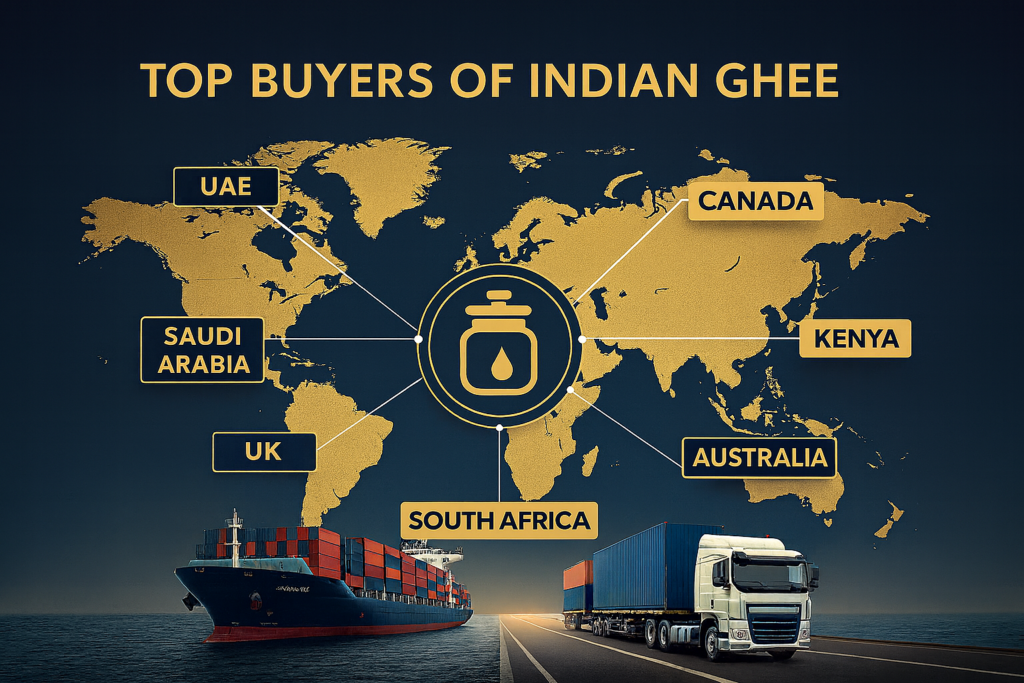
For ghee-exporting countries, the Gulf Cooperation Council states, particularly the United Arab Emirates, Saudi Arabia, and Qatar, are ghee-importing countries. The rapid growth of the dried whey protein markets in the United States, Canada, Australia, and the United Kingdom, largely driven by an increasingly health-conscious populace, complements the ghee trade with Indian ghee.
The main ghee-importing African countries include Kenya, Nigeria, Ghana, and South Africa. These ghee-importing countries in Africa have no significant dairy manufacturing, so India serves as the sole ghee-manufacturing partner. This stimulates ghee exporters in India to create other value propositions for manufacturing ghee and set up long supply chains.
There has been increasing demand, signifying the strong buyer trust in the export quality and consistent ghee supply. Growing order repeatability provides evidence of this trust, strengthening the relationship with ghee export.
The Value of Ghee Exports in Relation to Price Trends
Recent Price Characteristics of the Global Market
Export market pricing in the ghee export varies, depending on characteristics such as fat content, quality, packaging style, certification, and brand recognition. Export-grade Indian ghee, depending on whether it is A2, cow, or organic ghee.
This competitive pricing enables ghee export from India to become a hugely lucrative business, as India is one of the most competitive ghee-importing countries. India’s cost advantages and competitive pricing have allowed ghee exporters in India to successfully enter new markets in Asia, the Middle East, Europe and Africa.
Determinants of Export Pricing
Some considerations for pricing exports from a country include:
- The quality and purity of ghee
- Availability of raw milk
- The technique used for processing
- Type of packaging (bulk vs. retail)
- Shipping costs for international freight
- Registrations such as FSSAI, ISO, and Halal
Ghee export from India is likely to experience rapid growth, mostly due to these reasons.
Complete Export Process for New Exporters
Step-by-Step Guide to Begin Ghee Export From India
Starting a ghee export from India is straightforward as long as you follow the steps. First, exporters should register the business and get an Import Export Code (IEC). Then, they should find verified manufacturers that make Indian ghee that is of good quality and complies with the international standard.
Before shipping, exporters should make sure that they do proper packing, labeling, and documentation. There are some ghee importing countries, especially the Middle Eastern countries, that require ghee to have Halal certification. Furthermore, ghee exporters in India also gain trust from ghee buyers overseas with ISO & FSSAI certifications.
B2B portals, trade fairs, and export promotion councils are good platforms for genuine buyers and increasing ghee export orders.
Opportunities and Growth Potential in the Ghee Export Sector
Why Is Ghee Export From India Considered a High Potential Business?
With the growing trend of healthy eating, global consumers are expected to increase the demand for Indian ghee. Ghee exporters in India will also have a competitive edge, as countries with limited dairy production depend on these ghee exporters. There is also a growing demand for niche products such as A2 cow ghee, organic ghee, and ghee from farm-made sources in ghee importing countries.
With newfound interest in Ayurveda abroad, ghee export from India will gain interest and demand. Quality producers will be able to establish and represent their brand in foreign markets. Along with ghee, other natural products—such as the fast-growing export of honey from India are also gaining strong global recognition.
Conclusion
Among India’s food and dairy exports, ghee export from India stands out as one of the most lucrative avenues. There is a reputation for Indian ghee globally, and the demand for Indian ghee is on the rise, as are the ghee importing countries. India becomes the first choice for international clientele. Efforts on maintaining documentation, quality, and supply chain reliability will allow ghee exporters in India to experience exponential growth in business. Lack of documentation and quality will have a detrimental effect on growth. With the ghee export, those who have entered or will enter the market stand to gain the most.
FAQs
Is ghee export from India profitable?
Yes, especially with the rising demand, as India is the global leader in dairy and offers competitive pricing.
Which countries import the most Indian ghee?
Major ghee importing countries include the UAE, Saudi Arabia, the USA, Canada, Australia, and several African nations.
What certifications are required for ghee export?
Exporters typically need FSSAI, Halal certification, ISO documents, and lab test reports depending on the destination country.