
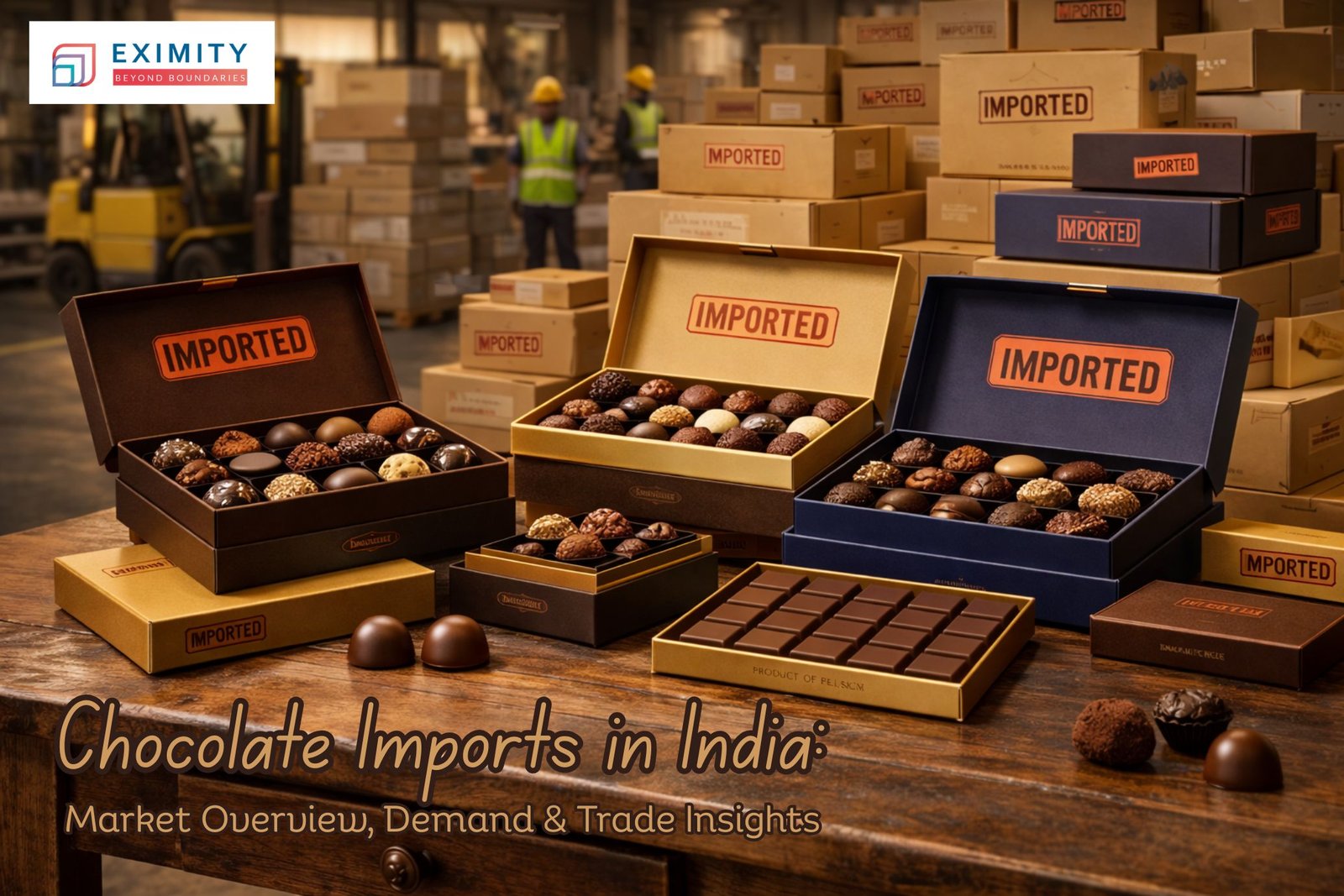
The Indian Chocolate Market is one of the most rapidly developing markets in the world because of the change in consumer demand, the Indian market being exposed to world food brands, and the demand for chocolate market being highly influenced by the premium brands. Among the various factors, developing consumer preferences, a market with chocolate imports in India, and the penchant for international products, quality chocolate, and varied products need to be considered.
The chocolate market in India supplements homemade chocolates with the import of chocolate in India that are not homemade, premium chocolates, and niche markets that are available in chocolate. The demand for imported specialty chocolates is linked to the global cocoa supply chains and Cocoa Export from India. The demand for imported specialty chocolates is linked to imported specialty chocolates and is interrelated with global chocolate trade.
Overview of the Chocolate Import Market
Market Focus and Demand Areas
- The chocolate import market in India focuses on premium retail, gifting, hospitality, and food service and champions these segments.
- Consumers value the uniqueness of imported chocolate, whether in texture, cocoa value, or simply brand presence.
Supply Chain and Market Expansion
- Importing chocolate has matured, largely attributed to the development of cold chain logistics.
- Additionally, the development of other storage infrastructures has further enhanced quality storage.
- With increasing consumption, the market is extending beyond metro cities. chocolate imports in India are extending beyond the luxury outlet rms
- There is increasing presence in organized retail across multiple formats.
Growth Drivers Behind Chocolate Imports in India
Changing Consumer Preferences
Premium and artisanal chocolate is increasingly being consumed by urban markets. The consumption is extending beyond the borders of India and being imported to service the demand. Additionally, dark variants, sugar alternatives and filled chocolates are on the rise of demand. These segments are also contributing to chocolate consumption seasonally and during festivals.
Expansion of Retail & E-Commerce
Imported products are readily accessible, especially since the rapid development of Supermarket and Online Grocery Channels. Chocolate imports in India have also extended as these channels are available in tier 1 and tier 2 cities, where the population and interest in International Grocery Items have grown significantly.
Role of Chocolate Importers
Chocolate importers essentially create the supply chain’s backbone by integrating the various elements of the supply chain including embedding sourcing, international logistics, compliance, and domestic distribution. Importers further manage the supply chain by focusing on procurement, quality assurance, packaging compliance, and inventory planning.
Seasoned chocolate importers are able to determine supply chain opportunities, gaps, and bottlenecks and are able to forecast demand. They build in temperature-controlled transportation options and other considerations to manage the product’s integrity and other supply chain considerations to preserve it over long distances.
Chocolate Importers in India
Major Import Hubs and Distribution Channels
Chocolate importers in India use these distribution networks to streamline their operations: major ports, logistics hubs, distributors, and organized retailers. Metro cities are the primary port of sale, but the distribution networks are also growing in less developed cities.
Types of Imported Chocolate in India
The imported chocolate in India market has the following chocolate varieties available:
- Dark chocolate
- Milk chocolate
- Premium assortments
- Specialty variants
These varieties are used in:
- Retail sales
- Corporate gifting
- Hospitality
- Bakery applications
The chocolate import segment of the Indian market has strengthened as equipment and technology has improved.
Import Process and Regulatory Framework
Import of Chocolate in India – Key Compliance Areas
The import of chocolate in India have to adhere to food safety standards, labeling regulation, and document verification. The importer has to observe compliance regulation related to the chocolate ingredients, their shelf life, and the storage condition.
Trade policies and Free Trade Agreements India has with other nations also affect sourcing decisions, duty structures, and long-term trade strategies.
Challenges in Importing Chocolate
The demand to importing chocolate is often substantial, yet it remains challenging due to factors such as high logistics costs, a product temperature sensitivity, and having a short shelf-life. Especially for high-end chocolate, maintaining a consistent quality during transit is critical.
Chocolate importers in India face pricing pressures and competition from domestic producers. This requires focus on efficiency, differentiation, and strong distribution partnerships.
Future Outlook of Chocolate Imports in India
Growing disposable incomes, increasing access to a variety of retail, and changing consumer behaviors are boosting chocolate’s future import outlook in India. Anticipated future opportunities in the chocolate market are expected to be highest in the premium, organic, and specialty categories.Chocolate remains a marketable segment for traders and entrepreneurs looking to expand their scope from chocolate to a broader Import and Export Business. It is equally promising in India’s food import market. Processed food that includes chocolate is also a segment of the food trade in which the World Trade Organization (WTO) anticipates on a steady increase for the foreseeable future.