

Introduction to Cashew Export from India
India has always valued and understood the importance of exporting cashew nuts, and it has always positively impacted India’s trade profile, also strengthening it. Cashew Export from India also show the growth of the global market for healthy nuts, plant-based diets, and diverse food components. India has a considerable stake in the nut processing industry and has vast farming for nuts, which includes many processing centers, manufacturers, and farming bases. Exporters, however, still deal with the risk of global competition and issues that stem from price and affordability.
This blog outlines the challenges and innovations within the industry regarding cashew export from India, production, and evolving market trends and peers towards growth potential.
Cashews in India—A Brief Overview
India’s agricultural sector has expanded to include cashew cultivation and growing fiber. The cashews in India truly grow and flourish in the Indian subcontinent and climate. Cashew nuts are exotic and quite popular in India. The states of Kerala, Karnataka, Goa, Maharashtra, and Andhra Pradesh are known for their cashew nuts and also for the country’s export.
India is one of the top global exporters because of its processing industry, which generates employment and contributes to the rural economy. The cashew industry is not just about nuts but also about cashew kernels, cashew shell oil, and value-added cashew products for the global market.
Popular Kaju Varieties in India
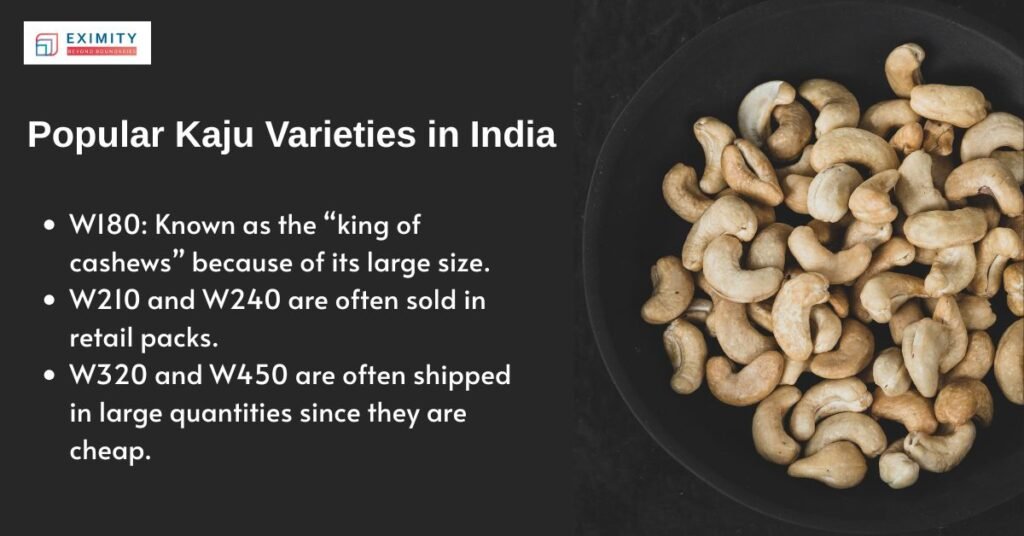
India’s strong position in exports can be attributed in part to the country’s various cashew grades. Indian kaju varieties were assessed for size, color, and quality. Exporters often handle the well-known grades of cashew nuts, such as W180, W210, W240, W320, and W450.
- W180: Known as the “king of cashews” because of its large size.
- W210 and W240 are often sold in retail packs.
- W320 and W450 are often shipped in large quantities since they are cheap.
India has many different types of adult kaju, which lets the country sell them at different prices around the world. This flexibility enables India to meet the needs of clients from all over the world.
Largest Producer of Cashew in India
India’s cashew production base is spread over several states. Kerala is the largest producer of cashew in India, with Maharashtra and Andhra Pradesh next in line. These states are the largest in cashew cultivation because they have the right climate and soil conditions.
Even though India produces many cashews, Vietnam and the Ivory Coast have been gaining a lot of market share. Nonetheless, loyal exporters make sure Indian cashews continue to build India’s reputation in global markets.
Cashew Market Prices and Global Demand
Global demand and global cashew market prices are directly related. International demand, quality of the harvest, freight costs, currency, and economic inflation all play a role in pricing.
Currently, demand for Indian cashews in the USA, UAE, Japan, Europe, and Africa is the strongest it has been in years. Rising global demand for cashews is a result of their adoption, as consumers increasingly endorse them as a healthy snack.
Due to the competitiveness of cashew market prices, exporters have to continuously keep track of global prices to avoid losses. For many exporters, bulk exports of cashew kernels and processed cashew are the most profitable and least risky.
Cashew Size & Quality Standards in Export
In the international market, the cashew size determines its demand and pricing. Larger cashews, W180 and W210, are a premium, while medium and smaller cashews are used for bulk shipments.
Exporters prioritize quality packaging, hygiene, and proper grading too. For this reason, Indian cashew enjoys an excellent global packaging and grading reputation and its cashew is considered one of the best cashew in India.
Customers are consistent in their expectations as they seek long-term business relationships and uniform grading and sizing for their cashews. Maintaining consistent horticultural standards for packaging and grading as well as adherence to hygiene practices is crucial.
Nut Industry Trends Driving Cashew Export from India
Some changes in the industry are helping to shape the cashew export of the future.
- There is an increase in the popularity of value-added products such as roasted, salted, and flavored cashew nuts.
- Buyers, especially internationally, tend to focus more on products that are organically certified.
- There is more use of technology for cashew processing, for example, automated shelling and grading machines.
There is more than enough opportunity to grow the cashew export from India and opportunity quickly fills up to adapt to the changes in consumer export.
Major Challenges in Cashew Export from India
Despite the presence of opportunities within the industry, exporters continue to face challenges such as
- The competition from Vietnam and other African countries.
- The risk of price volatility caused by unpredictable harvests and global demand.
- Increased freight and shipping costs, which in turn lower profit margins.
- The complicated and lengthy regulatory requirements pertaining to exports. Labor-intensive processing, which increases costs in comparison to mechanized competitors.
To grow, exporters in India need to implement appropriate technology, improve quality, and diversify their markets. These improvements would enhance India’s global standing in the cashew industry.
Future Outlook for Cashew Exports
The future of cashew export from India is bright given the anticipated increase in global nut consumption. India will be in a strong position to increase its exports by:
- Closing gaps with new countries, such as South America and Eastern Europe.
- Advancing the marketing of processed and value-added cashew products.
- Taking advantage of government and APEDA support.
- Motivating farmers to use more sustainable practices to improve long-term supply.
- Indian exporters need to strengthen their position in the export nut industry.
India is also making good progress in exporting luxury goods such as Saffron Export from India, which is still getting a lot of attention around the world because of its high quality and traditional agricultural methods.
Conclusion
Cashew export from India will always be the primary pillar in the agriculture sector. Indian exporters going global have grown their markets to include many kaju varieties and refined their focus on the more in-demand cashew size. Even with unpredictable cashew market prices and competition, India’s secured reputation will always attract customers.
Like cashews, other types of crops are also seeing an increase in demand. One area that is doing well is the export of honey from India. This is because more and more people around the world want natural sweeteners and health-based products.
In the future, innovation, sustainability, and quality will determine how India can hold the competitive advantage in the world of cashew exports. With the right efforts, Indian exporters will ensure cashew nuts remain among the most valuable nuts in the world.
FAQs on Cashew Export from India
Q.1 Which state is the largest producer of cashew in India?
Kerala is known as the leading producer of cashews in India, followed by Maharashtra and Andhra Pradesh.
Q.2 What are the most popular types of Kaju that India sends to other countries?
Indian exporters sell several different kinds of kaju, such as W180, W210, W240, W320, and W450.
Q.3 How are International Cashew Prices Determined?
The price of cashews in the international market is determined by the level of demand, how much has been produced, logistics, and ever-changing exchange rates.
Q.4 Which Countries are the Largest Importers of Indian Cashews?
Indian cashews are most frequently bought by the United States, the United Arab Emirates, Japan, and the countries in Europe.
Q.5: What Makes the Best Cashew in India Stand Out?
The best quality Indian cashew stands out, as the size and taste are appealing and it meets the international market quality standards.