
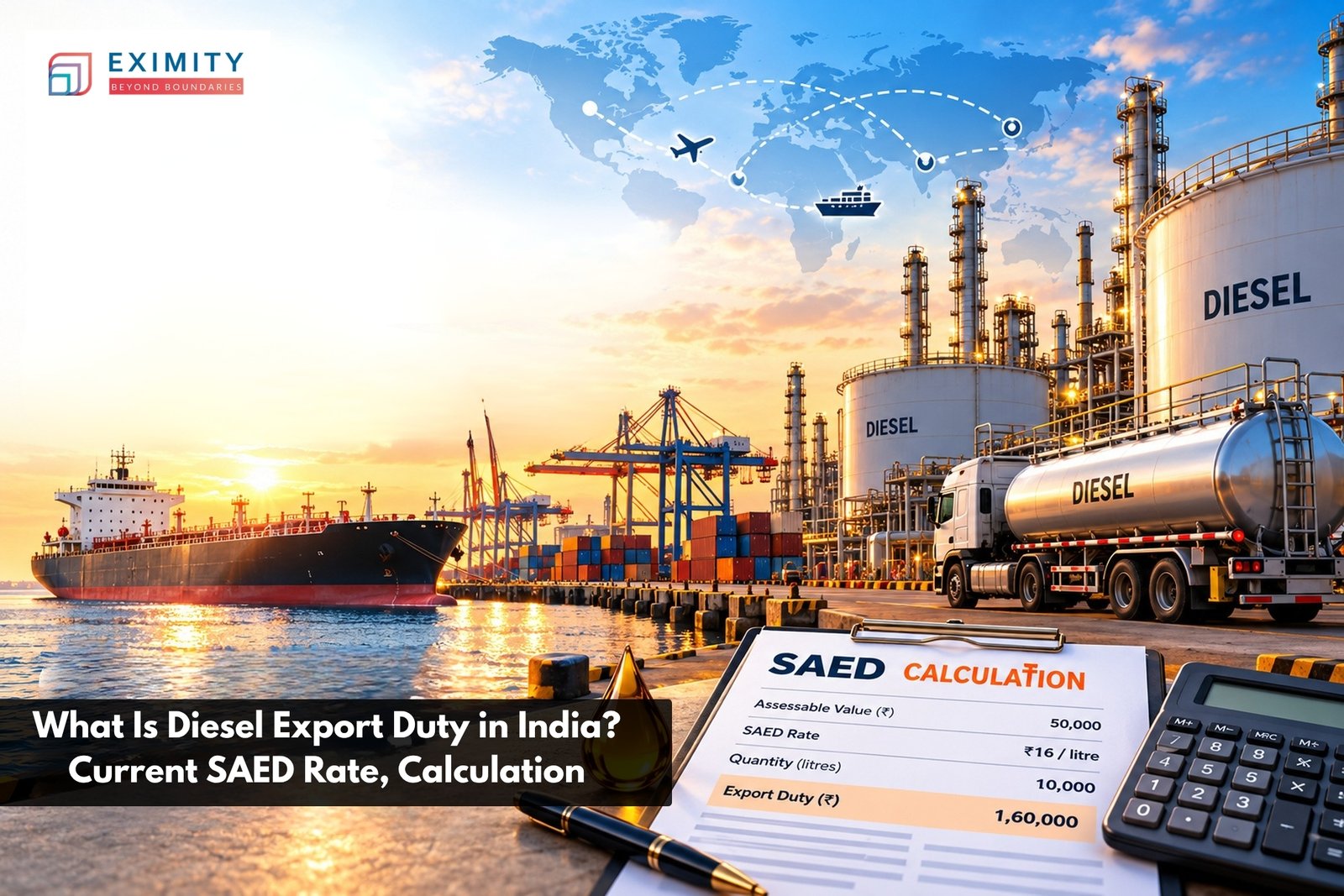
Ship one tanker of diesel out of India this month and the government takes ₹16 on every litre before it leaves the port. That charge is the diesel export duty, and since March 2026 it has changed almost every two weeks.
For refiners and fuel traders, this one number can decide whether a deal makes money or loses it. If you’re new to the fuel trade, start with how petroleum products export from India works in general. Diesel is the country’s biggest refined fuel export, so any tax on it moves the whole sector.
Below, we explain what the levy is, why it exists, the latest rate, and how to work out what you’ll actually pay.
What Is Export Duty?
An export duty is a tax the government charges on goods leaving the country. Most Indian exports carry no such tax. India usually prefers to push exports with incentives, not slow them down.
So when people search what is export duty, they’re often surprised to learn it’s used only in special cases. The government brings it in when it wants to keep a product at home, usually because domestic supply is tight or global prices have spiked.
If you’re asking what is export duty for your own product, the answer for most goods is simple: zero. Fuel is one of the few exceptions right now.
What Is Diesel Export Duty?
Fuel is where that exception shows up most clearly. If you’ve wondered what is diesel export duty, it’s a fixed charge per litre that the Finance Ministry collects on high-speed diesel shipped out of India. The current rate is ₹16 per litre. It isn’t a percentage of the cargo’s value, so the bill depends only on how many litres you export and the rate on the day your shipment is cleared. That’s why a single revision can change the cost of a large cargo by lakhs of rupees.
Why Was Diesel Export Duty in India Introduced?
Diesel export duty in India came into force on 27 March 2026. The trigger was the West Asia conflict, which disrupted crude supply and pushed international fuel prices sharply higher.
India imports most of its crude oil. When global diesel prices jumped, refiners could earn far more by selling abroad than at home. The government stepped in for two reasons. First, to keep enough diesel in the domestic market. Second, to collect a share of the windfall profits refiners were making on exports.
One thing confuses many readers: diesel export duty in India has no effect on pump prices. Excise on diesel sold inside the country stayed the same.
How the Levy Works: SAED Explained
The duty is collected as a Special Additional Excise Duty, or SAED. A Road and Infrastructure Cess (RIC) was also built into the structure, but for diesel the RIC has been nil in recent revisions.
Here’s what makes it different from a normal customs charge:
- It’s a specific duty, charged in rupees per litre, not as a percentage of the cargo’s value.
- Rates are reviewed every fortnight, usually effective from the 1st and 16th of the month.
- Each revision is based on average international prices of crude, diesel, petrol and ATF since the last review.
- It applies only to diesel leaving India. Diesel sold domestically isn’t touched.
- Petrol and ATF have their own separate export rates.
- Changes come through Central Excise notifications, so exporters need to watch the Gazette closely.
Classification Matters
Make sure your cargo is filed under the correct HS code classification for high-speed diesel. A wrong code can mean paying the wrong rate, or a hold-up at customs while the shipping bill gets corrected. We’ve seen small paperwork errors cost exporters several days at port.
Current Export Duty on Diesel: Rate History
Here’s how the rate has moved through 2026. The current export duty on diesel is ₹16 per litre, effective 1 October 2026.
| Effective From | Rate (₹ per litre) | Movement |
| 1 May 2026 | 23.00 | Raised |
| 16 May 2026 | 16.50 | Cut |
| 1 June 2026 | 13.50 | Cut |
| 16 June 2026 | 14.00 | Up ₹0.50 |
| 16 July 2026 | 15.50 | Up from ₹8.50 |
| 1 October 2026 | 16.00 | Cut from ₹20.00 |
Selected revisions. Source: Central Excise notifications.
Because rates shift every 15 days, check the latest notification before you price any cargo. A quote prepared on the 28th can be wrong by the 1st.
How to Calculate the Duty
The formula is short:
Duty payable = Litres exported × SAED rate in force on the date of clearance
A Simple Example
Say a refiner ships 5 lakh litres of diesel in October 2026.
5,00,000 litres × ₹16 = ₹80,00,000
That’s ₹80 lakh in duty on a single mid-size cargo.
Why Timing Changes Everything
Now take a bigger shipment of 10 lakh litres. Cleared on 30 September at ₹20 a litre, the bill comes to ₹2 crore. Cleared two days later on 1 October at ₹16, it drops to ₹1.6 crore.
That’s ₹40 lakh saved because of the date on the paperwork. (Of course, rates can rise too. In July the rate almost doubled in one revision.) This is why experienced exporters plan loading schedules around the diesel export duty revision dates.
Who Has to Pay It?
The duty is paid by whoever clears diesel for export. In practice, that means large refineries and licensed fuel exporters. Small traders rarely deal in diesel shipments, since petroleum exports need specific licences, storage, and port facilities.
If you buy diesel within India for your own business use, you don’t pay this levy at all. It only applies at the export stage.
A higher export duty on diesel makes Indian cargoes costlier in overseas markets. When the rate climbs, refiners often find it more profitable to sell more fuel at home, which is exactly what the policy aims for.
Practical Tips for Exporters
Put a duty-adjustment clause in your sales contracts. If the rate changes between signing and loading, the price should move with it, or you end up absorbing the difference.
Keep a copy of the notification number with every shipment file. If customs questions the rate later, you’ll have proof of what applied on that date.
And mark the 1st and 16th of every month in your calendar. Small habit, big savings.
Fuel is a specialised trade, but the lesson applies to every exporter: government levies can change fast. If you’re just starting out, this practical guide for Export Entrepreneurs covers the basics of building an export business from India.
Final Thoughts
Margins in the fuel trade depend on how closely you track policy changes. A rate that looks small per litre turns into lakhs of rupees on a full cargo.
For now, the diesel export duty stands at ₹16 per litre, and the next revision could land within days. Treat every quote as provisional until you’ve checked the latest notification.
At Eximity, we track changes like these so Indian exporters can plan shipments with real numbers. Bookmark this page; we’ll update the rate table after every revision.
Frequently Asked Questions
1. How is the diesel export levy charged ?
It’s a per-litre tax, collected as SAED, that India charges on diesel shipped abroad. It was introduced in March 2026 to protect domestic fuel supply.
2. What is the current rate?
₹16 per litre from 1 October 2026. Rates are revised roughly every 15 days, so check the latest Central Excise notification before shipping.
3. Does this levy raise petrol pump prices?
No. It applies only to fuel leaving India. Excise on diesel sold in the domestic market hasn’t changed because of it.
4. How often does the rate change?
Usually twice a month, on the 1st and 16th. Each revision follows average global prices of crude oil and refined fuels over the previous fortnight.
5. Is there an export levy on petrol too?
Yes, petrol has its own separate rate. It was nil for part of 2026 and has stayed far lower than diesel through most revisions.