
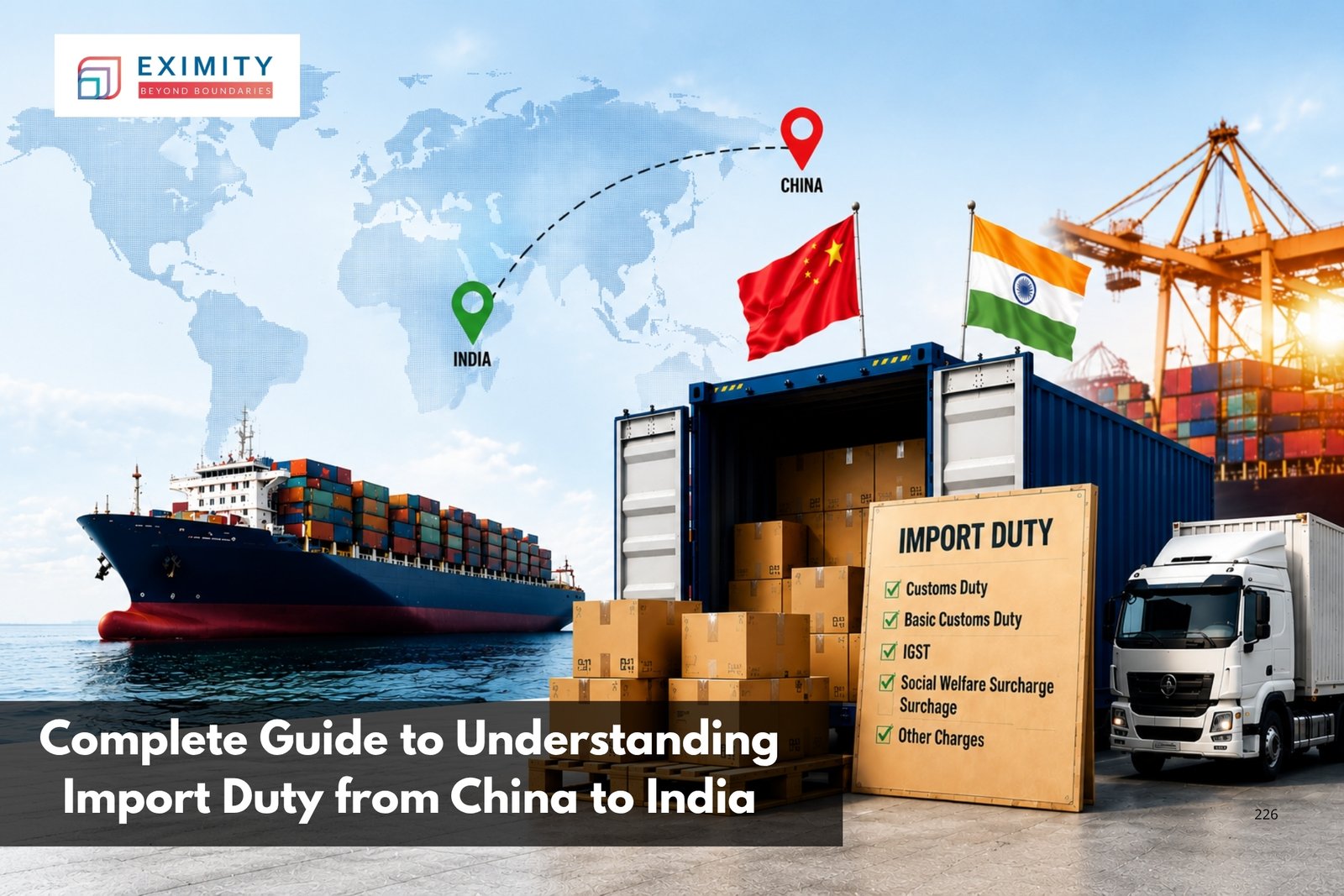
When bringing goods from China to India, you need to consider more than the product cost. Import duty from China to India is made up of several layered charges. Understanding the various components will help you better calculate your cost of goods.
What Is Import Duty from China to India?
Import duty from China to India is made up of taxes and charges collected by the Indian Customs when goods cross the border, i.e., import tax from china to india . Import duties are the responsibility of the Customs Act, 1962, and are governed by the Customs Tariff Act, 1975.
Customs duty rates are determined by classifying products under HSN (Harmonized System of Nomenclature) codes. Duty rates are charged to the specific HSN code and will determine what duty will be charged on textiles, electronics, or machinery.
When determining Import duties from China to India, several charges, in addition to the Basic Customs Duty (BCD), are paid on top of the BCD. It should be noted that these charges, when paid, increase the effective rate above the headline rate.
For a broad understanding of duties, review this: Import Duty in India
Components of China to India Import Charges
This is the area that is most confusing for importers. China to India import charges entails various duties, which include the following:
- Basic Customs Duty (BCD): This is a primary import tax enforced on import tax from china to india ranging from 0% to 150%, depending on the category of the product.
- Social Welfare Surcharge (SWS): This is 10% of the BCD.
- IGST (Integrated GST): 12%, 18% or 28% of the total assessable value, including BCD and SWS.
- Countervailing Duty (CVD): This is imposed on some goods to neutralize subsidies in China.
- Anti-Dumping Duty: This is imposed on goods from China that are below fair value in the country to safeguard Indian industries.
For numerous categories of consumer goods, the effective combined rate frequently exceeds 30-40% of the product value.
How Custom Duty from China to India Is Calculated
In order to understand custom duty from China to India, the following formula for assessable value is important:
Assessable Value = CIF Value (Cost + Insurance + Freight)
All duties are applied on this CIF value. Here’s a simplified example:
| Component | Rate | Amount (on ₹1,00,000 CIF) |
| Basic Customs Duty | 20% | ₹20,000 |
| Social Welfare Surcharge | 10% of BCD | ₹2,000 |
| IGST | 18% on total | ₹21,960 |
| Total Duty | – | ₹43,960 |
So, for a CIF valued shipment of ₹100,000, the total landed cost, not including agent duties, port expenses or other logistics, is approximately ₹143,960.
Understanding Global Import and Export trends helps businesses plan smarter and manage import duty from China to India more effectively.
Products with High Import Duty from China to India
Due to India’s industrial policy as well as some trade protection measures for goods coming from China, there are product categories with higher import duty from China to India. Some of these are:
- Electronics and Mobile Phones
- Solar Panels and Equipment
- Steel and Aluminum Products
- Toys and Plastic Products
- Textiles and Garments
India’s Trade Defence Against China
India has implemented anti-dumping duties on various Chinese products over the years. These duties are in addition to the BCD and may range from 5% to above 200% based on the findings of the investigation. The most impacted industries are chemicals, steel, and ceramics. Always refer to the Directorate General of Trade Remedies (DGTR) before you confirm your bulk imports.
What Is Import Duty from China to India on Specific Items?
What is import duty from China to India if you are importing a specific product? This depends on the HSN code. Below is a general category breakdown:
- Raw materials: 0-10% BCD
- Intermediate goods: 5-15% BCD
- Finished consumer goods: 15-40% BCD
- Luxury and restricted goods: 40-150% BCD
- Agricultural products: Variable, generally protected.
This also holds true for high-value products such as automobiles. The Import Duty on Cars in India system works the same, as do other high-value imports from China such as machinery and other vehicles.
Documentation Required for Importing from China
Duties are not the only consideration when Import duties from China to India. You need to get the right documents submitted, or your shipment will get stuck at the port.
- Bill of Entry: Must be submitted to Customs prior to clearance of a shipment.
- Commercial Invoice: Must have a value which will be accepted by Customs.
- Packing List: This is a list of all the items in the shipment.
- Bill of Lading / Airway Bill: These are the shipment documents.
- Import Export Code (IEC): This is a necessary document for all importers in India.
- Certificate of Origin: This shows the items in the shipment originated in China.
GST Input Tax Credit on Import Duty
There is one other important consideration for importers. If you pay IGST at the border and are a GST-registered business, the payment is not a cost, as you can claim an Input Tax Credit. This will reduce your tax cost on your sale.
BCD is not eligible for a tax credit. Therefore, when you consider your actual cost of importing, you need to consider the GST and the BCD and the SWS.
This is one of the reasons import tax from china to india is easier for B2B companies than for end consumers or companies who don’t have GST registration.
Tips to Reduce Import Duty from China to India Legally
There is a set of legitimate ways to lower the cost of your imports:
- Review FTA/PTA agreements: India has a number of Preferential Trade Agreements, but China is not one of those countries, so there will be no reduction in duty.
- Use the correct HSN classification: Incorrect classification will often result in a higher duty. Have a professional classification done.
- Use a SEZ or a bonded warehouse: Duty payments can be deferred, which is good for cash flow.
- Advance Authorisation Scheme: This scheme provides export businesses that import components from China for assembly and subsequent export with a way to import those components without paying customs duty.
In a surprising twist, some of the same logic used for the protection of imports applies to food products. For example, management of the Almonds Import in India provides an example of how India applies import duties to specific categories of products while considering how to protect its domestic industries.
Conclusion
Custom duty from China to India are extremely complex. There is BCD, Social Welfare Surcharge, IGST, and depending on the product, there could also be an anti-dumping or countervailing duty. The effective rate will almost always be higher than the BCD, so a landed cost analysis using duty paid will almost always be incorrect.
FAQ
Q1. What is the average import duty from China to India? Considering BCD, Social Welfare Surcharge, and IGST, the average effective customs duty for finished consumer goods from China to India is in the range of 25-45%.
Q2. Is there any free trade agreement between India and China that reduces import duty? No. There is no Free Trade Agreement or Preferential Trade Agreement between India and China.
Q3. Can import duty paid on Chinese goods be refunded? For GST-registered businesses, the IGST component paid on imports is recoverable. However, both Basic Customs Duty and the Social Welfare Surcharge remain non-refundable.